Options Strategy Matrix by Market Regime
Here's the complete options strategy matrix showing which strategies work best across different market conditions
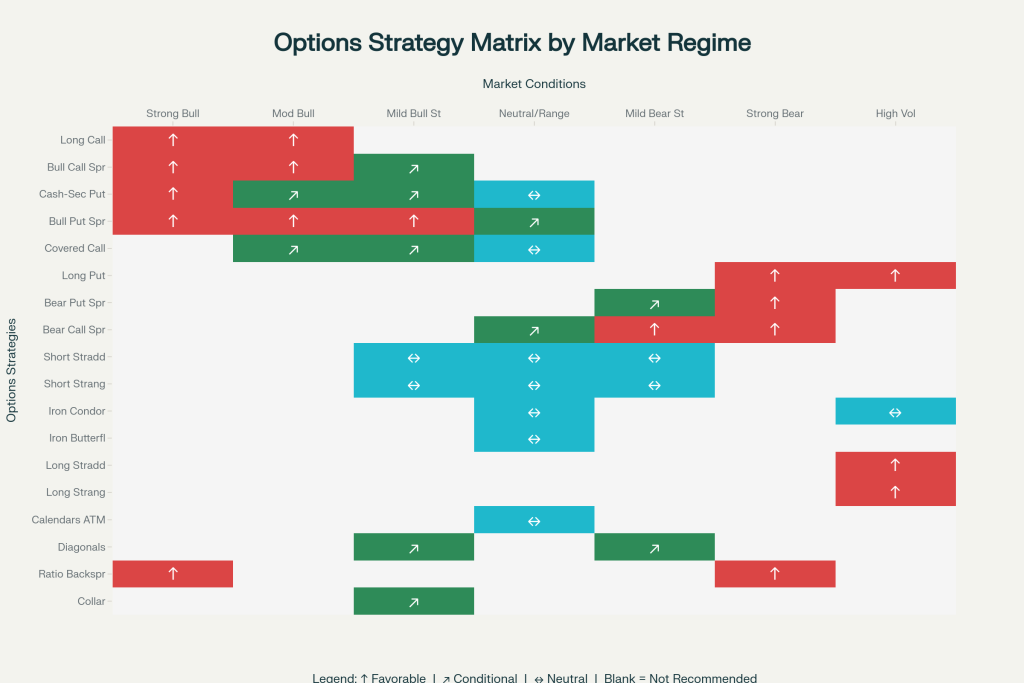
Legend
-
↑ Favorable: Strategy is well-aligned with the market regime; expectancy and risk/reward are attractive
-
↗ Conditional: Works with adjustments or specific filters (IV percentile, strike selection, timing); positive expectancy but requires careful management
-
↔ Neutral: Use primarily for income generation or hedging when directional edges are small; profits rely on theta decay and mean reversion
-
(blank): Not recommended for this regime due to poor expectancy or unfavorable risk/reward dynamics
Implementation Guidelines
IV Filtering Strategy:
- Sell premium when IV percentile > 60 and price is range-bound
- Buy premium when IV percentile < 30 or expecting volatility expansion into events
- Monitor IV rank relative to 252-day historical range for timing entries
NSE-Specific Considerations:
- Prefer defined-risk credit spreads (bull put, bear call) and iron condors for margin efficiency
- Reserve naked short straddles/strangles for advanced traders with strict risk controls
- Use position sizing of 2-5% risk per trade for single-leg strategies, 1-3% for spreads
Risk Management Rules:
- Roll losing positions early at 2x credit received or when short options reach 0.35-0.40 delta
- Widen strike spacing as realized volatility increases beyond expected ranges
- Close profitable positions at 25-50% of maximum profit for spreads, 10-25% for short premium strategies